From rough board to finished piece
Daniel BallardComing soon8 min read
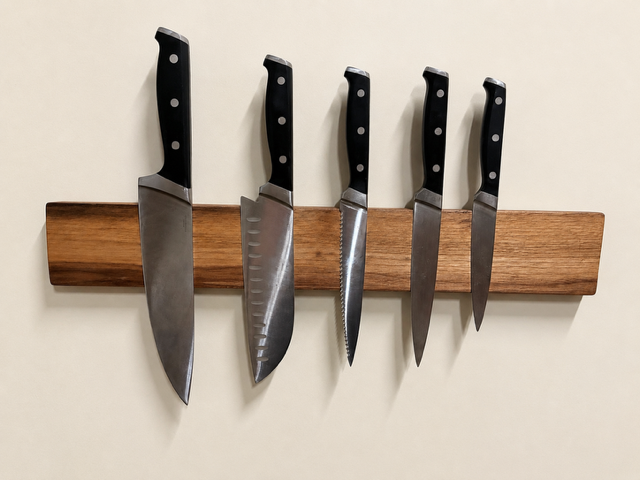
A walk through the shop — how a single walnut plank becomes a wall-mounted knife holder.
Every piece in the shop starts the same way: a rough plank leaning against the wall, still wearing the saw marks from the mill. This is the story of one of them — a 6-foot length of black walnut that became a wall-mounted knife holder for a customer in Vermont.
Not every plank gets pulled. I'm looking for grain that runs straight enough to be stable, but with enough character — figure, a sapwood streak, a knot in the right place — to make the finished piece feel inevitable rather than generic. This board had a long ribbon of lighter sapwood running down one edge. That became the front face.
The rough board goes through the jointer to get one flat face, then the planer to get a parallel second face. Then it sits. Wood moves when you cut it open — internal tension releases, moisture redistributes — and rushing this step is how you end up with a finished piece that warps a month after it ships. I give every board at least 48 hours between milling and final dimensioning.
Knife slots are laid out by hand, in pencil, with the actual knives in front of me. Spacing depends on the blade thickness, the handle shape, how the customer said they use the kitchen. Then the slots are cut on the table saw with a thin-kerf blade, cleaned up with a chisel, and the back is rabbeted for a French cleat so it hangs flush to the wall.
Sanding from 80 to 220, then a wipe with a damp cloth to raise the grain, then one more pass at 320. Finish is a hardwax oil — three thin coats, buffed between each one. The first coat soaks in and pops the grain; by the third, the surface has a soft, low sheen that feels like skin.
Wrapped in kraft paper, boxed in a custom-cut foam cradle, and out the door. The whole process — from pulling the plank to taping the box — took about ten days. Most of that was waiting on the wood.